


I went into this expecting a prepper boom. Every week this fall there was another headline about stockpiles, sold-out generators, and governments telling people to keep three days of supplies at home.
The data told me something more interesting. Total preparedness search in the US is basically flat, down 2.5% over the last 12 months. What changed is the mix, the channel and the person doing the buying.
Here's the short version. Fewer people use the word “prepper.” More people are quietly buying backup power and water, and a lot of them are buying it at Costco. And the thing keeping them up at night is the next power outage, by a wide margin over war or collapse.
To get there, we pulled 221 US Google search queries across 10 segments, monthly, from November 2022 through October 2026. Then we read and coded 2,698 consumer social posts from November 2024 through this week. The full method is at the bottom.
Prepping Went Mainstream by Going Quiet
When a subculture goes mass, a funny thing happens. People stop using the name and stop posting about it. They just buy the stuff.
That's what this looks like to me. Searches for “prepper” are down 43% from three years ago, to about 5,700 a month. Over the same stretch, “emergency preparedness kit” is up 140%. And only 5% of consumers posting about preparedness call themselves preppers.
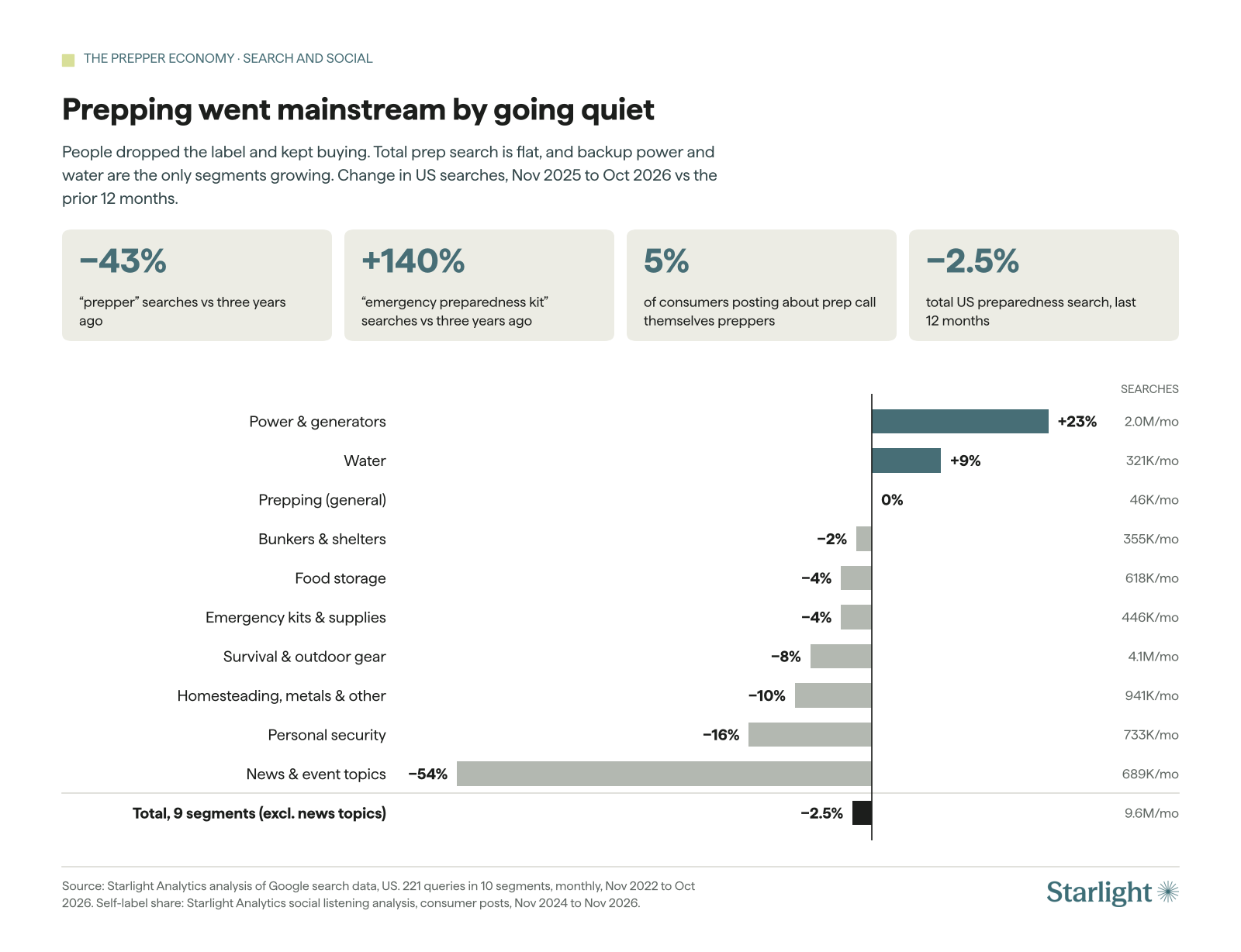
Backup power is up 23% and water is up 9%. Almost everything tied to the old TV-doomsday image is falling: searches tied to news events and war are down 54%, personal security is down 16%, and survival and outdoor gear is down 8%.
There's a second tell. People are searching the big power brands more (up 16% for the six main brands) and posting about them less. Brand mentions fell from 67 to 36 for every 100 posts about outages. Search going up while chatter goes down is usually what it looks like when a hobby turns into a normal household purchase.
And the late-2026 buying wave showed up at mass retail. Costco's CFO said members were buying more water, rice, canned goods and paper goods from late October, and Costco had sold out of 21 of 26 high-ticket generators online by mid-November.
Meet the Two New Preppers
Treating “preppers” as one segment doesn't hold up. When we coded the consumer posts, two very different groups fell out.
Resilience households are the majority, 58% of consumer posts. They're practical and mostly calm. They prep for storms and outages, buy power, water and kits, and almost never get political.
Dread preppers are about a quarter, 23% of consumer posts. They're fear-driven, often political, focused on ammo and collapse, and barely interested in outages.
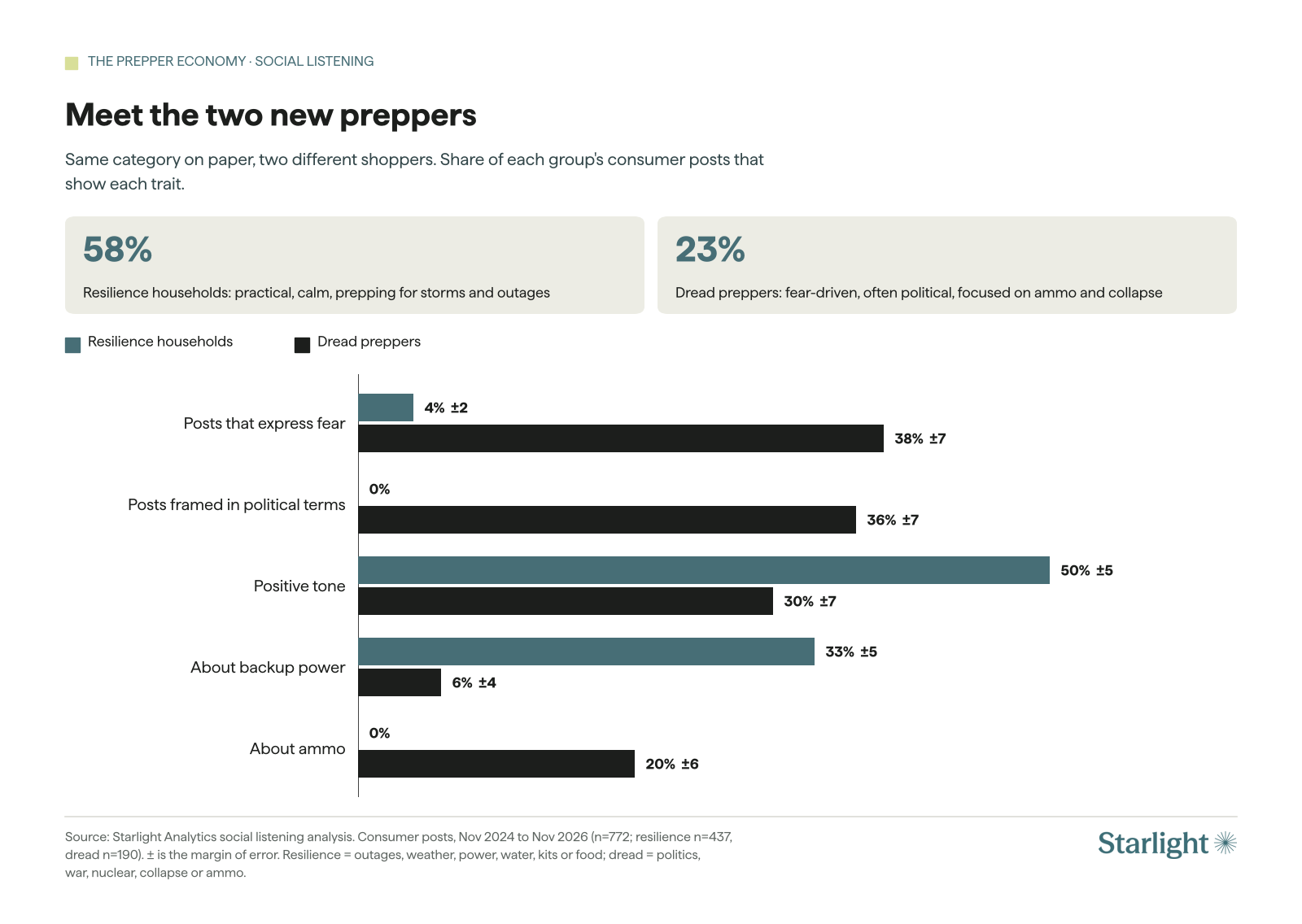
Look at fear. It shows up in 4% of resilience posts and 38% of dread posts. Political framing: 0% vs 36%. Backup power: 33% vs 6%. Same category on paper. Two different shoppers, with different motivations and different baskets.
One honest limit here. Social data can't tell me age, income, gender or region. What people say about themselves is thin but telling, and renters and apartment dwellers show up about as often as homeowners. A lot of them sound stuck.
“I'm renting or I'd be idk installing solar or a whole house generator or SOMETHING”
Bluesky, August 2026
“I live in a studio apartment I can't cook a propane stove inside not sure what I'll do”
YouTube, November 2026
If you sell into this space, that renter might be the most underserved customer in it.
The Trigger Is the Next Outage
On sources where we can actually read the posts, prep talk tied to outages beat talk tied to war or nuclear fear 7.3 to 1 over the last 12 months. Among consumers only, it's 6.8 to 1. The gap actually widens when you take X out of the data, so I don't think this is a bot story.
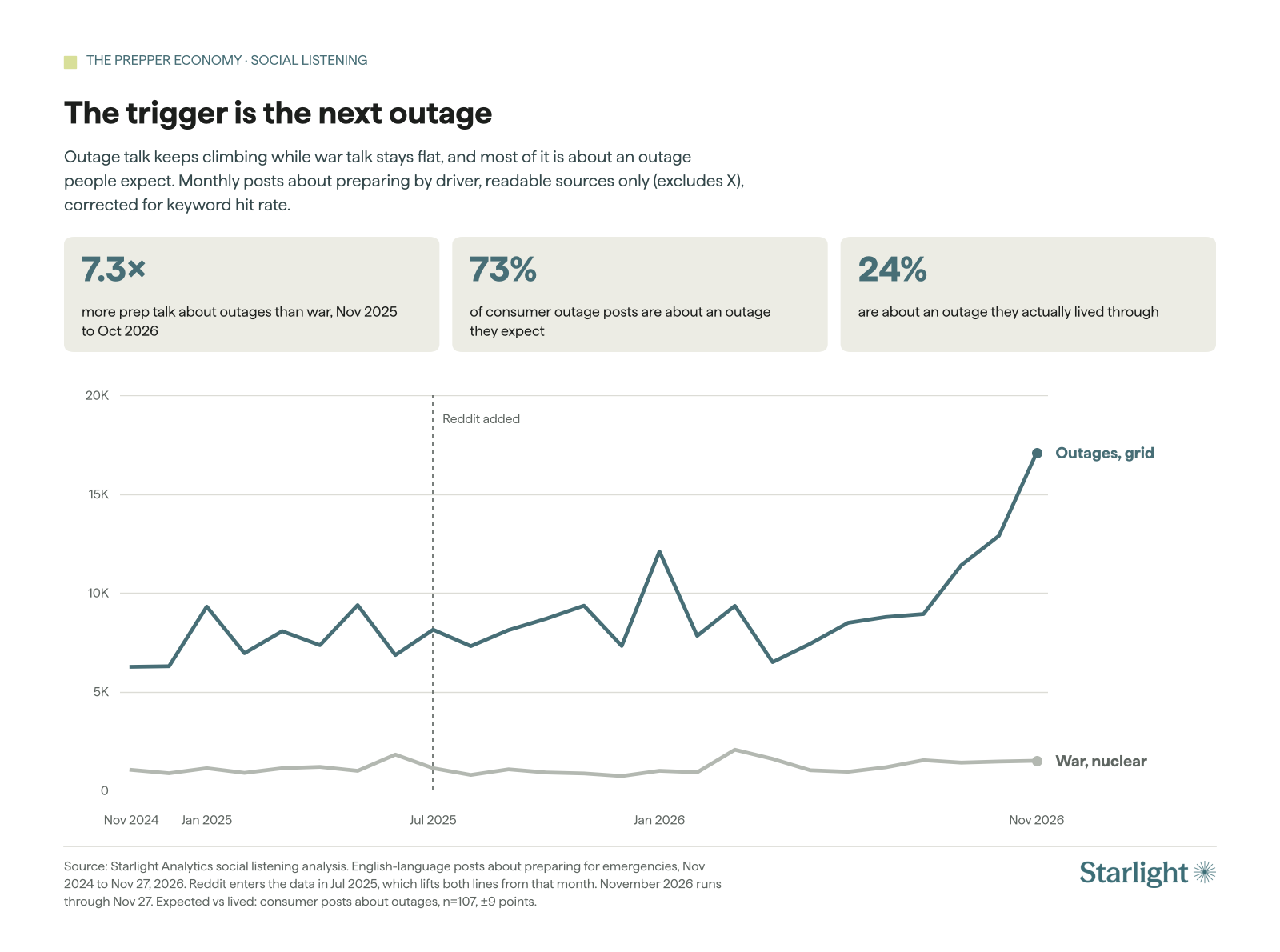
Here's the part that stuck with me. Of consumer posts about outages, 73% are about an outage the person expects. Only 24% are about one they lived through. That's true even after real outages this fall, from Hurricane Isaias cutting power to more than 884,000 customers in October to the Thanksgiving storm that cut more than 800,000 in the Mid-Atlantic and Northeast.
People are buying insurance against the outage they imagine.
“I'm not prepping for z-words or red dawn situations. I'm prepped for 4 ft of snow and the yearly power outages”
Reddit, August 2025
So is this just an October thing? Partly. Kit searches rise every October. Water is the one that really broke pattern.
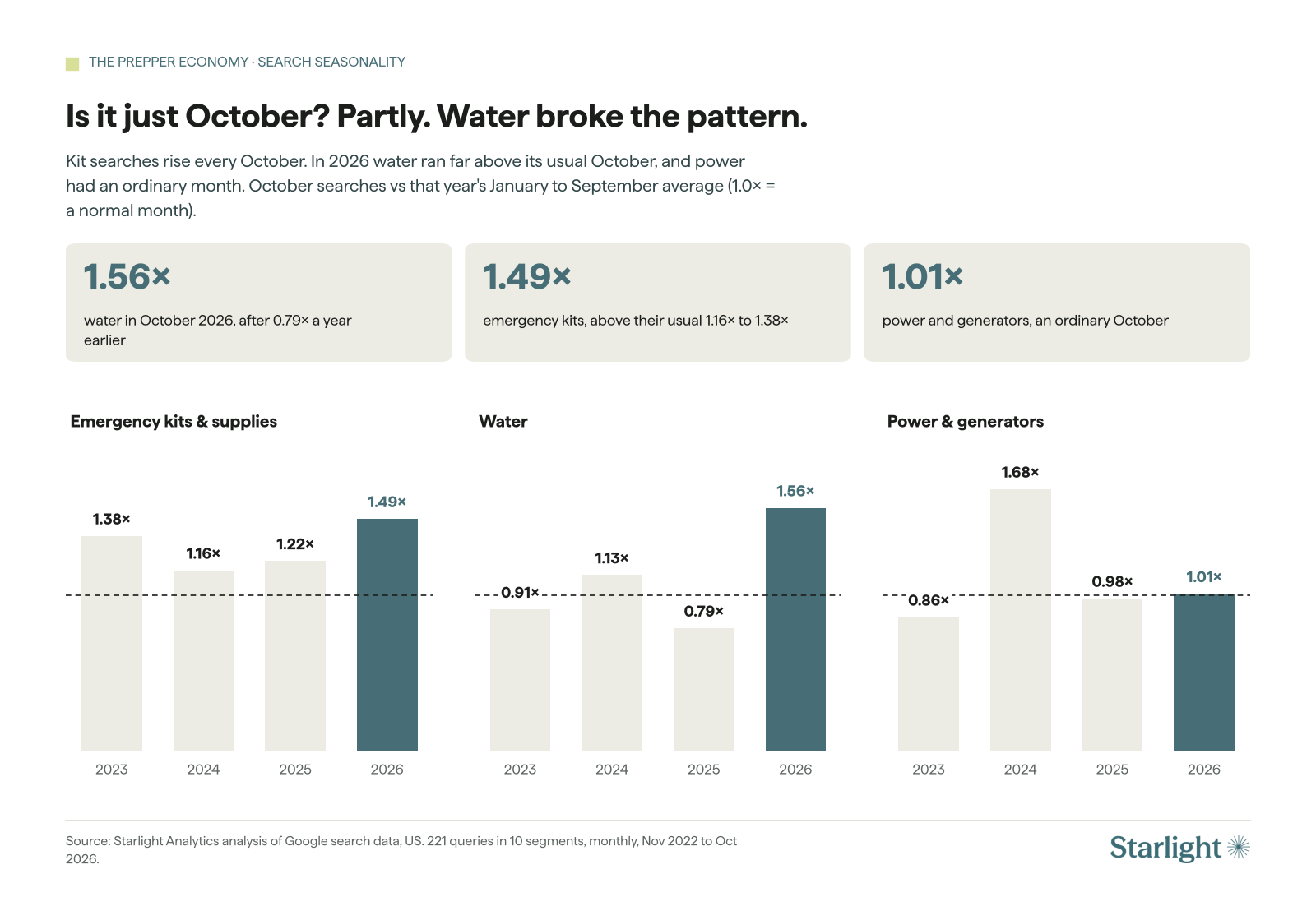
Water searches in October 2026 ran 1.56 times a normal month, a year after running at 0.79. Power had an ordinary October at 1.01; its big October was 2024, the month of Hurricanes Helene and Milton. Prime Big Deal Days landed in the first week of October in both 2025 and 2026, so that doesn't explain the gap.
One more wrinkle. A lot of the stockpile advice this fall came from outside the US. The UK, France, Japan and Canada all told households to keep about 72 hours of supplies between late October and early November. Our search data is US-only, and the US signal is the steady climb in backup power and water.
The Money Is in the Middle
I expected a barbell, with cheap fixes on one end and big-ticket generators on the other. That's NOT what happened.
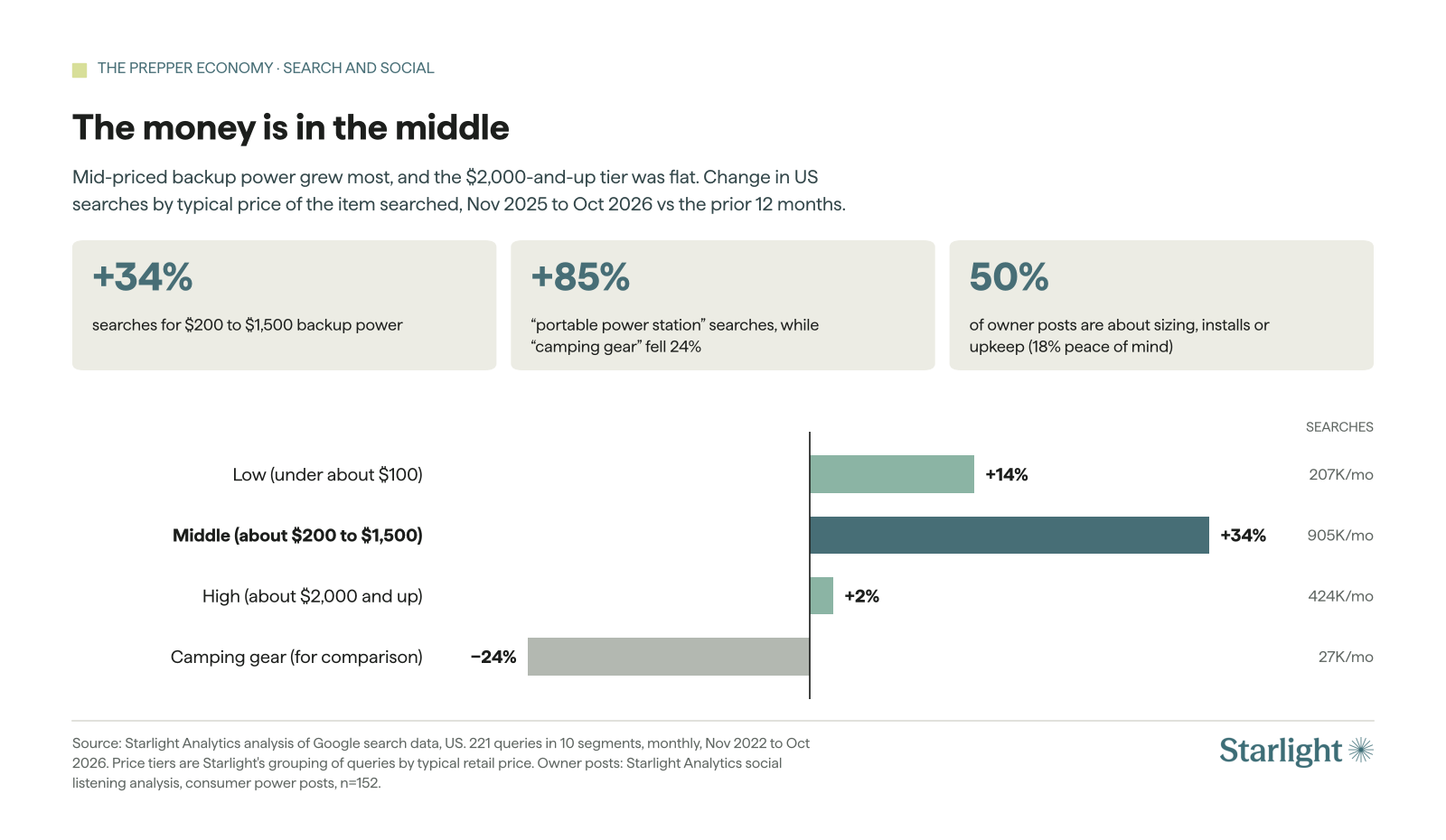
Searches for mid-priced backup power, roughly $200 to $1,500, grew 34%. Under-$100 fixes grew 14%. The $2,000-and-up tier (whole-home generators, freeze dryers, home batteries, bunkers) was basically flat at 2%.
Could it be camping? I doubt it. “Portable power station” searches rose 85% while “camping gear” fell 24%. Search can't split intent perfectly, but the direction is pretty clear.
The premium incumbent shows the squeeze. Generac's residential sales fell 7% in 2025 to $2.27 billion, which the company put down to weak outage activity, before rising 9% in Q3 2026.
Owners also talk about friction a lot more than comfort. Half of consumer power posts (50%) are about sizing, installs, reliability or upkeep, vs 18% about peace of mind. If you sell power, that might be your content plan right there.
“There are cheaper ways to do things like buying a $500 generator vs a $15000 Generac.”
YouTube, June 2025
Food Is Moving to the Store Shelf
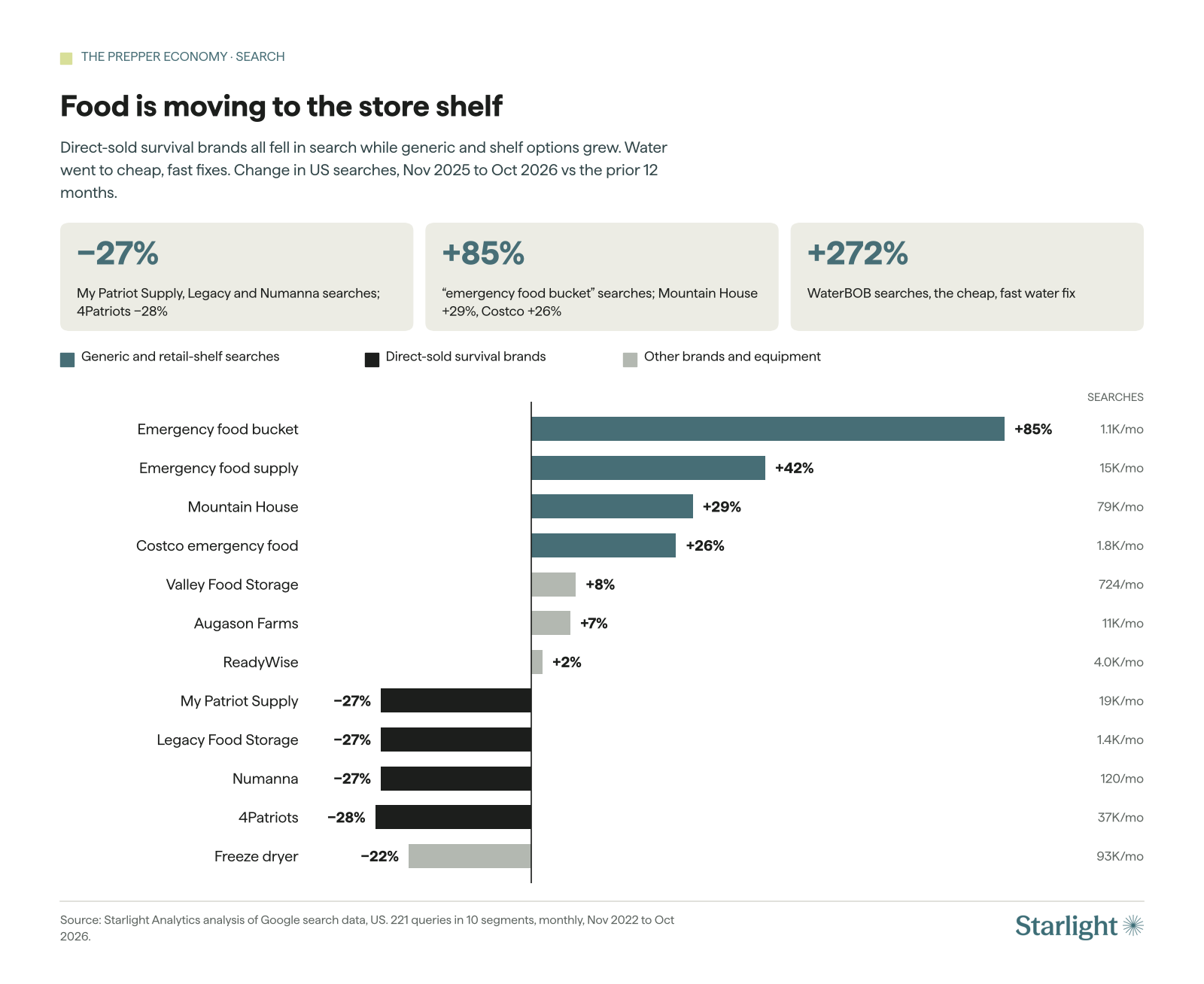
The direct-sold survival food brands, My Patriot Supply, 4Patriots, Legacy and Numanna, all fell 27% to 28% in search. Generic searches grew (“emergency food bucket” up 85%, “emergency food supply” up 42%), and so did shelf brands like Mountain House (up 29%) and Costco emergency food (up 26%).
That looks like a channel shift toward mainstream stores. It might also reflect brands long marketed through political media losing reach, but the data shows the channel pattern much more clearly than a political one.
Food talk is also the most negative topic we read. About half of food posts are sponsor reads or affiliate links. Water posts are just as ad-heavy and rarely negative, though, so the ads alone don't explain the skepticism.
Water is the cheap, fast fix. Searches for WaterBOB, the bathtub water-storage bag, rose 272% over the last 12 months (60,600 vs 16,280), and 1,111% from August to October alone. Outside sales data points the same way: US sales of water germicidal tablets rose 154% in the four weeks ended November 1.
“Waterbob's website was sold out, but I did find one on eBay.”
Reddit, October 2026
Ammo Is Where the Politics Went
Prepping is shedding its political coding everywhere except ammo. Google doesn't report search volume for “ammo,” so this side of the market only shows up in social.
In a deep read of 306 ammo posts, 97% came from consumers and 45% were driven by dread. A third cited politics and unrest, and 22% cited prices, tariffs and shortages. Outages barely came up, at 2%. Across all consumer prep talk, political framing shows up in just 8% of posts, and nearly all of it sits with dread preppers.
“Ammo prices are NOT coming down in my lifetime. If you need it, buy it.”
Reddit, March 2026
Small Segments Worth Watching
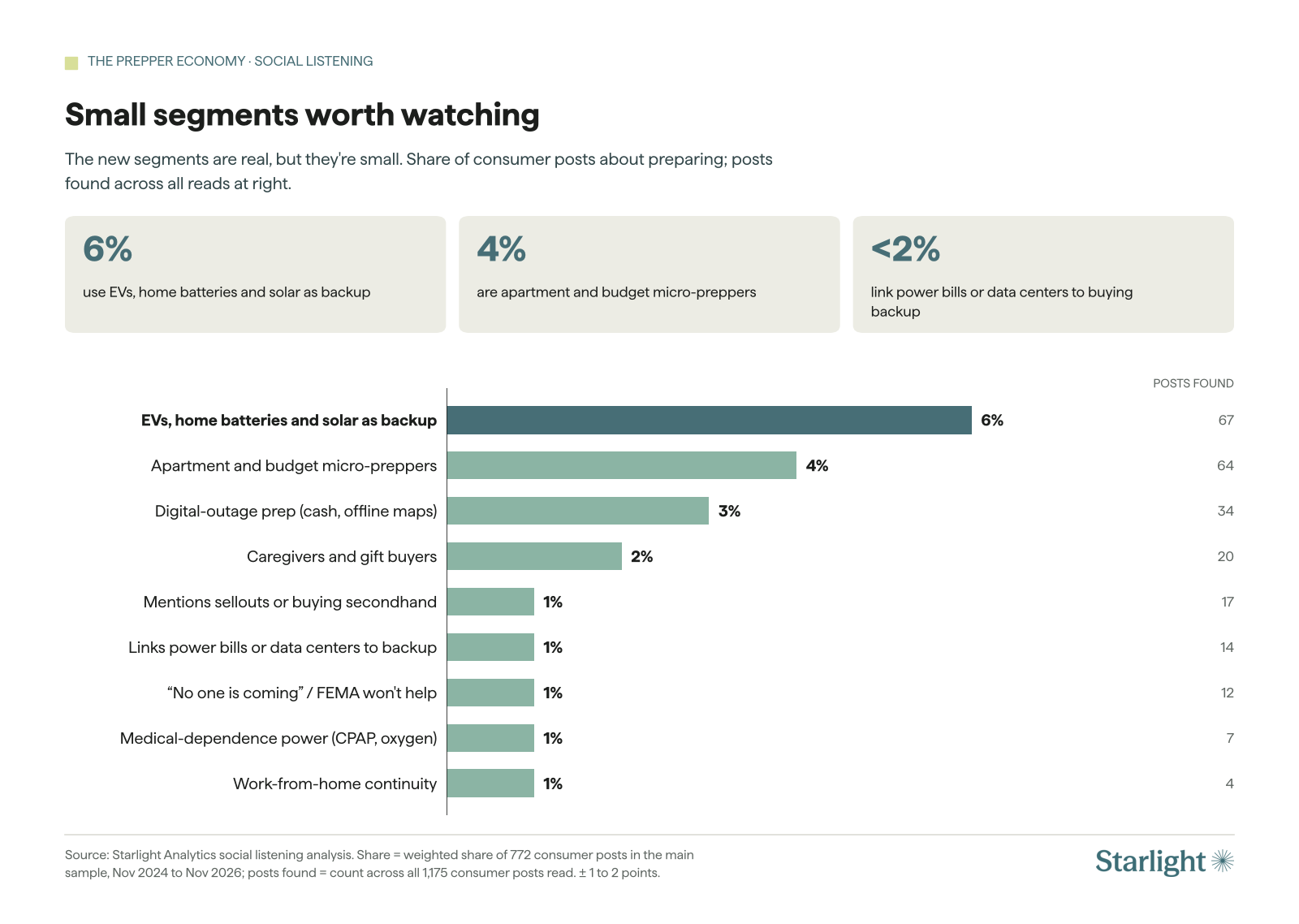
The new segments are real, but they're small. The biggest is people using EVs, home batteries and solar as backup, at 6% of consumer posts. Apartment and budget micro-preppers come next at 4%.
A couple of angles I expected to be bigger, like medical-dependence power (CPAP, oxygen, insulin) and work-from-home continuity, barely show up in public posts. They might be bigger than they look. People just don't post much about them, so a survey is the better way to size them.
The “self-insuring against the grid” story, where rising power bills and data centers push households to buy their own backup, isn't in the conversation yet. Under 2% of posts make that link.
How Big Is the Prepper Economy?
There's no single honest dollar figure, and I'd be a little suspicious of anyone who hands you one. The pieces are big, though:
- Generac residential sales: $2.27B (FY2025, company results)
- US home standby generators: $3.3B (2025, Global Market Insights)
- US portable power stations: $266M to $280M (2024, Fortune Business Insights and Arizton)
- North America emergency food: $2.5B (2024, Market Research Future)
- US consumer preparedness spending: $11B (12 months to early 2023, Finder survey; includes savings and home renovations)
These have different scopes and years, so please don't add them up. The fair headline is that home backup power alone is a multi-billion-dollar US market, and emergency food and power stations each sit somewhere between hundreds of millions and low billions.
November: From Whether to Prep to How To Prep
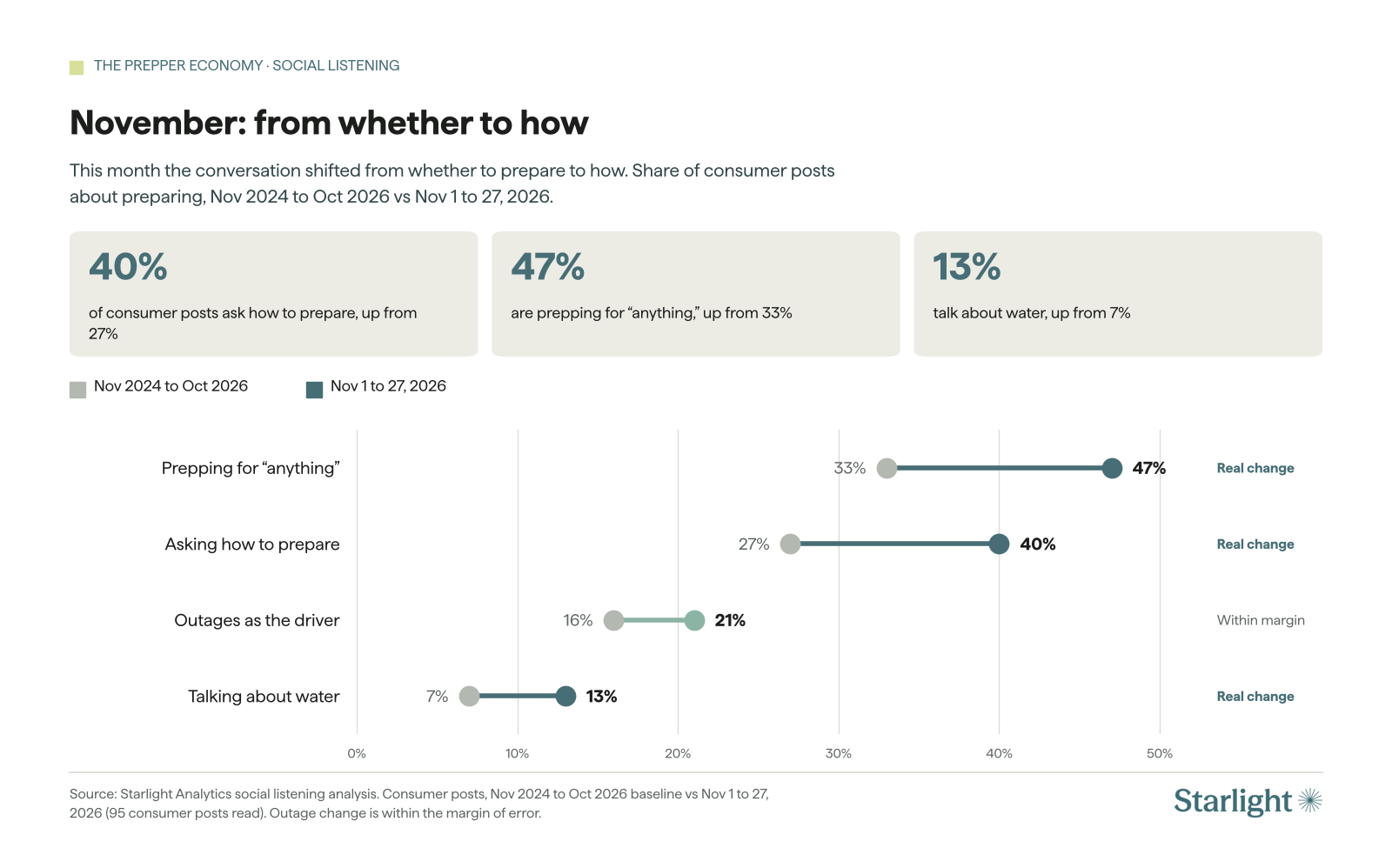
This month the conversation shifted. Among consumer posts, 40% are asking how to prepare, up from 27% over the prior two years. Prepping for “anything” rose from 33% to 47%, and water from 7% to 13%. Outages as the driver ticked up too, but inside the margin of error.
A few things stacked up at once: the November tech outages (Microsoft, an FAA ground stop, AWS, Chase), which were IT failures rather than grid failures; a routine FEMA alert test on November 17 that set off false 90-day blackout rumors; and the stockpiling at mass retail. November search data isn't out yet, so this part is social only.
“Anyone else finding themselves becoming the person they used to think was crazy?”
Facebook, November 2026
“I feel like I need to prepare, but not panic.”
Bluesky, November 2026
What This Means If You Sell to These Shoppers
If this is your category, here's what I'd be thinking about:
- Retire the prepper label in your marketing. Almost nobody uses it about themselves, and your biggest group of buyers is calm and practical.
- Plan for two customers. Resilience households and dread preppers want different products, a different tone and different reassurance.
- Sell readiness for the next outage. Most outage talk is about one people expect, so lead with being ready.
- Own the middle. Mid-priced power is where demand is growing, and buyers' biggest worries are sizing, installs and upkeep. Content that answers those questions might sell more than another lifestyle ad.
- Follow the shelf. If you're a direct-sold brand, your customer may already be buying at Costco.
- Don't forget renters. They want in and feel shut out of the big-ticket answers.
Finding the two very different customers hiding under a flat top-line number is the part of this work I like most.
So I'm curious. If you're in this space, which of these two customers is your brand really built for right now, and does your marketing know the difference?
How We Did This
- Search: 221 US Google queries in 10 segments, monthly, November 2022 to October 2026. Changes compare November 2025 to October 2026 with the prior 12 months unless another window is stated.
- Social: English-language posts about preparing for emergencies, November 2024 to November 27, 2026 (ammo stockpiling in, general firearms talk out). Volume counts cover X, news and social sources.
- Read and coded: 2,698 posts in a weighted random sample (1,175 about preparedness, 772 from consumers), plus deep reads on food, water, ammo, renters and November 2026. A blind re-code of 10% agreed at kappa 0.72 to 0.90.
- Limits: Social listening reflects what vocal people post, not every consumer. Social data is global English (about two-thirds US where country is known); search data is US-only.
- Public figures: Market sizes, outage events, government advice and retailer comments come from the named public sources below. They are not Starlight estimates.
Sources
- Generac Q4/FY2025 results, Feb 11, 2026
- Generac Q3 2026 results, Form 8-K Ex. 99, Oct 28, 2026
- Fortune Business Insights, U.S. Portable Power Station Market, updated Nov 9, 2026
- Arizton, U.S. Portable Power Station Market 2025-2030, Jul 2025
- Market Research Future, Emergency Food Market, updated Nov 16, 2026
- Finder, Doomsday prepper statistics, Apr 11, 2023
- Global Market Insights, U.S. Home Standby Gensets Market, Dec 2025
- CBS News, Isaias live updates, Oct 11, 2026
- CBS News, Thanksgiving storm power outages, Nov 27, 2026
- TechRepublic, November 2026 Tech Outages Timeline, Nov 18, 2026
- Apple Scoop, Every major outage of November 2026, Nov 17, 2026
- Nextgov, Security officials tell Congress tech outages are not malicious, Nov 2026
- FEMA, Urges Residents to Prepare for Hurricane Isaias, Oct 8, 2026
- GOV.UK Cabinet Office, Be Ready announcement, Oct 22, 2026
- Newsweek, Map of nations urging stockpiles, updated Oct 29, 2026
- Nation Thailand (Jiji Press), Japan disaster agency, Nov 2, 2026
- RCI / CBC News, Ottawa emergency supplies, Nov 3, 2026
- Transport Topics (Bloomberg), Costco customers stock up, Nov 17, 2026
- Fortune, Costco selling out of generators, Nov 19, 2026
- Yahoo Finance (USA Today), Costco generators sell out, Nov 18, 2026
- CBS News, Consumers stock their doomsday pantries, Nov 19, 2026
- About Amazon, Prime Big Deal Days 2026; Amazon press release, Prime Big Deal Days 2025
Search and social figures: Starlight Analytics analysis of Google search data (US) and Starlight Analytics social listening analysis.

